“Line” (2025)
Essay: Beyond The Line
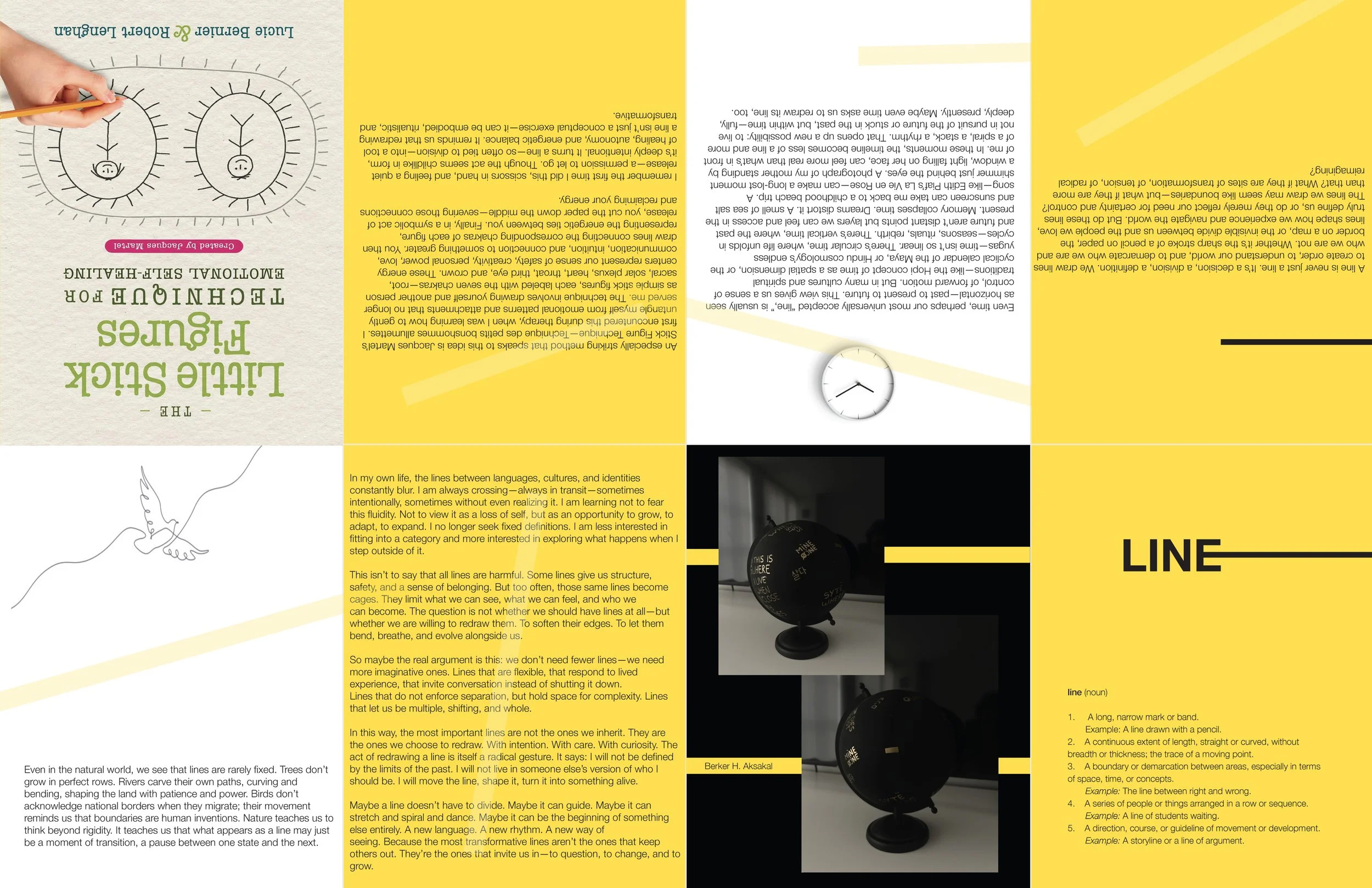
A line is never just a line. It’s a decision, a division, a definition. We draw lines to create order, to understand our world, and to demarcate who we are and who we are not. Whether it’s the sharp stroke of a pencil on paper, the border on a map, or the invisible divide between us and the people we love, lines shape how we experience and navigate the world. But do these lines truly define us, or do they merely reflect our need for certainty and control? The lines we draw may seem like boundaries—but what if they are more than that? What if they are sites of transformation, of tension, of radical reimagining?
In my life, lines are not static. There’s the line I draw with a pencil—confident, only to be erased and redrawn, again and again, until it finally feels “right.” There’s the line at JFK, where I stand with a passport in hand, mentally preparing for questions that might never come, aware of the assumptions that may form before a word is exchanged. The line between my past and my present stretches thin across continents, constantly shifting with time and experience. The line that separates me from the people I love is both tangible—measured in miles—and intangible, constructed from conflicting values, beliefs, and expectations. I draw a line on FaceTime, trying to bridge that distance with a smile and a “how are you?”—a temporary solution to a deeply rooted feeling of displacement. These lines aren’t just personal—they are emotional, cultural, and political.
Not all lines are visible or clearly drawn. The line between belonging and being an outsider is one that flickers—present one moment and gone the next. Sometimes, it disappears entirely, only to return in the form of microaggressions, social awkwardness, or a silent look that reminds you: you don’t fully belong. Psychology professor Beverly Tatum writes in Why Are All the Black Kids Sitting Together in the Cafeteria? that identity is “shaped by both individual characteristics and social contexts”—and these contexts often draw unspoken lines around us before we’ve had a chance to define ourselves. These shifting lines challenge our assumptions. Are boundaries meant to protect us and help us make sense of the world—or do they ultimately restrict, divide, and isolate us? Can a line be both comforting and constraining?
Even time, perhaps our most universally accepted “line,” is usually seen as horizontal—past to present to future. This view gives us a sense of control, of forward motion. But in many cultures and spiritual traditions—like the Hopi concept of time as a spatial dimension, or the cyclical calendar of the Maya, or Hindu cosmology’s endless yugas—time isn’t so linear. There’s circular time, where life unfolds in cycles—seasons, rituals, rebirth. There’s vertical time, where the past and future aren’t distant points but layers we can feel and access in the present. Memory collapses time. Dreams distort it. A smell of sea salt and sunscreen can take me back to a childhood beach trip. A song—like Edith Piaf’s La Vie en Rose— can make a long-lost moment shimmer just behind the eyes. A photograph of my mother standing by a window, light falling on her face, can feel more real than what’s in front of me. In these moments, the timeline becomes less of a line and more of a spiral, a stack, a rhythm. That opens up a new possibility: to live not in pursuit of the future or stuck in the past, but within time—fully, deeply, presently. Maybe even time asks us to redraw its line, too.
Neuroscience and trauma studies offer further insight. In The Body Keeps the Score, Bessel van der Kolk discusses how unresolved trauma can create internal boundaries—“psychic lines”—that disconnect us from ourselves and others. Healing, then, involves redrawing those lines—integrating experience instead of compartmentalizing it. Transformation happens not through erasing the past, but through reframing its role in the present.
An especially striking method that speaks to this idea is Jacques Martel’s Stick Figure Technique— Technique des petits bonshommes allumettes. I first encountered this during therapy, when I was learning how to gently untangle myself from emotional patterns and attachments that no longer served me. The technique involves drawing yourself and another person as simple stick figures, each labeled with the seven chakras—root, sacral, solar plexus, heart, throat, third eye, and crown. These energy centers represent our sense of safety, creativity, personal power, love, communication, intuition, and connection to something greater. You then draw lines connecting the corresponding chakras of each figure, representing the energetic ties between you. Finally, in a symbolic act of release, you cut the paper down the middle—severing those connections and reclaiming your energy.
I remember the first time I did this, scissors in hand, and feeling a quiet release—a permission to let go. Though the act seems childlike in form, it’s deeply intentional. It turns a line—so often tied to division— into a tool of healing, autonomy, and energetic balance. It reminds us that redrawing a line isn’t just a conceptual exercise—it can be embodied, ritualistic, and transformative.
This is where the personal becomes political, and where reflection becomes argument. In Borderlands/La Frontera, Gloria Anzaldúa speaks of borders as spaces that define “safe and unsafe, us and them.” Yet she also reclaims the border as a space of potential—a hybrid zone where cultures, languages, and identities collide and co-create. Rather than reinforcing division, she reframes the line as a “third space,” a site of resistance and imagination. bell hooks similarly describes the margins—not as places of victimhood but as spaces of “radical openness,” where transformation becomes possible. These thinkers challenge the idea that lines must be fixed or oppositional. Instead, they invite us to inhabit the in- between, to question binaries, and to find possibility in uncertainty.
In a similar vein, the philosopher Jacques Derrida challenges us to rethink the concept of boundaries in his deconstruction of language and meaning. According to Derrida, meaning is never fully stable or fixed—words, much like lines, are inherently unstable and constantly shifting. He uses the term différance to describe this endless deferral of meaning, suggesting that meaning is always contingent, always in flux. A line, then, is not a static demarcation; it is a place of tension and ambiguity, where boundaries are both made and undone. What if the line isn’t meant to define, but to question the very nature of what’s being defined? In this sense, the line becomes a space of radical openness, where we can challenge what we think we know and allow for new meanings to emerge.
And what happens when we begin to live in that space? What happens when we stop asking whether a line exists and instead ask what it’s doing—and who it’s serving? In philosophical terms, thinkers like Deleuze and Guattari introduce the concept of “lines of flight”—lines that rupture existing structures and offer new paths for becoming. These aren’t the rigid lines of tradition, but dynamic forces that allow for escape, transformation, and reinvention. A line, in this sense, becomes a method of resistance—a way to break out of systems that seek to contain us.
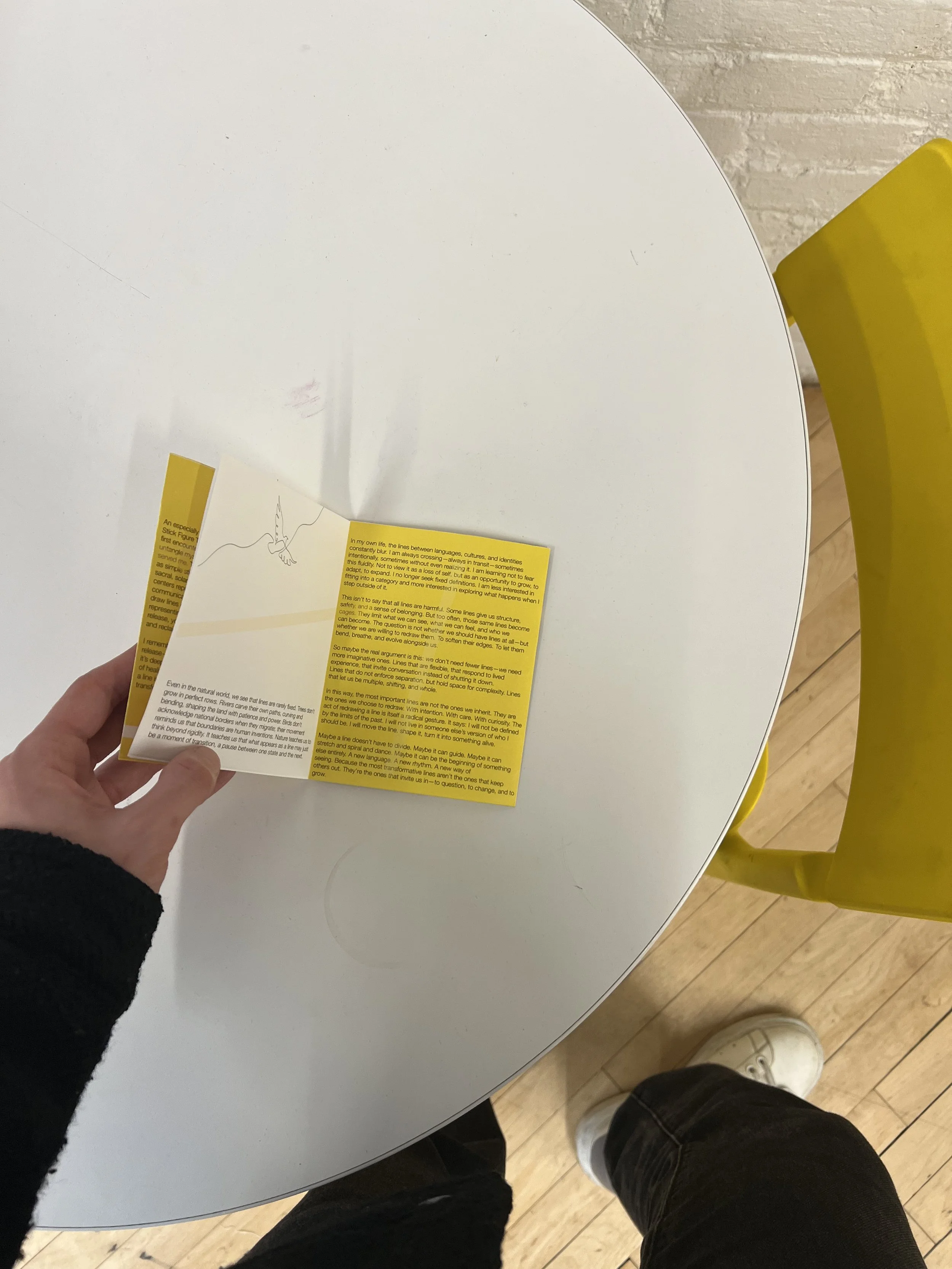
Even in the natural world, we see that lines are rarely fixed. Trees don’t grow in perfect rows. Rivers carve their own paths, curving and bending, shaping the land with patience and power. Birds don’t acknowledge national borders when they migrate; their movement reminds us that boundaries are human inventions. Nature teaches us to think beyond rigidity. It teaches us that what appears as a line may just be a moment of transition, a pause between one state and the next.
In my own life, the lines between languages, cultures, and identities constantly blur. I am always crossing—always in transit—sometimes intentionally, sometimes without even realizing it. I am learning not to fear this fluidity. Not to view it as a loss of self, but as an opportunity to grow, to adapt, to expand. I no longer seek fixed definitions. I am less interested in fitting into a category and more interested in exploring what happens when I step outside of it.
This isn’t to say that all lines are harmful. Some lines give us structure, safety, and a sense of belonging. But too often, those same lines become cages. They limit what we can see, what we can feel, and who we can become. The question is not whether we should have lines at all—but whether we are willing to redraw them. To soften their edges. To let them bend, breathe, and evolve alongside us.
So maybe the real argument is this: we don’t need fewer lines—we need more imaginative ones. Lines that are flexible, that respond to lived experience, that invite conversation instead of shutting it down. Lines that do not enforce separation, but hold space for complexity. Lines that let us be multiple, shifting, and whole.
In this way, the most important lines are not the ones we inherit. They are the ones we choose to redraw. With intention. With care. With curiosity. The act of redrawing a line is itself a radical gesture. It says: I will not be defined by the limits of the past. I will not live in someone else’s version of who I should be. I will move the line, shape it, turn it into something alive.
Maybe a line doesn’t have to divide. Maybe it can guide. Maybe it can stretch and spiral and dance. Maybe it can be the beginning of something else entirely. A new language. A new rhythm. A new way of seeing.
Because the most transformative lines aren’t the ones that keep others out. They’re the ones that invite us in—to question, to change, and to grow.
Berker H. Aksakal